National: There were an estimated 42,426 older people (aged 65 and above) living with dementia in Wales in 2024. Of these, 23,770 patients were on the dementia register on 1st April 2024, yet it is estimated only 56% of people suspected to have dementia were diagnosed.
Furthermore, there is evidence to suggest around 7% of dementia cases in Wales are early-onset dementia, backed up with other estimates of 5%-9% of early onset dementia diagnoses in the UK, it is therefore anticipated that in West Wales, locally available bespoke support for early onset dementia will also needed.
Regional: According to the General Practice Disease Register: interactive dashboard July 2024: there were an estimated 6,161 people (aged 65 and above) living with dementia in West Wales 2024.
There were 3,210 people with a dementia diagnosis in Hywel Dda University Health Board and 2951 people undiagnosed based on prevalence rates and general population data. 45% of those living with dementia diagnosis live in care homes acknowledging that many living in care homes don’t have a diagnosis.
(https://www.gov.wales/general-practice-disease-registers-interactive-dashboard)
General practice disease registers: interactive dashboard | GOV.WALES
There are approximately 103,100 people aged over 65 living in West Wales and estimates indicate that 63 in 1000 over 65 live with dementia, equating to approximately 6,495 over 65 living with dementia in West Wales.
Points of note:
Dementia remains the leading cause of death for females in Wales, with almost twice as many women dying from dementia than men in 2021. Early research indicates that women are twice as likely to develop Alzheimer’s disease as men, which could be associated with changes to the female brain during menopause, together with social and cultural factors, however work continues to understand this. (https://www.nature.com/articles/s41591-025-03564-3)
According to the Office of National Statistics the Care home resident population Wales: Census 2021 there are 3707 people aged 64 and over identified as care home residents. It has been estimated that 70% of care home residents have dementia on admission or develop it after admission, but that many do not have or receive a formal diagnosis of dementia (Aldridge et al 2024). A local survey concluded that 55% (1,315) of care home residents are live with a known diagnosis of dementia in Care Homes.
Deaths caused by dementia in Wales
National: Dementia and Alzheimer's disease was the leading cause of death in England and Wales in 2023, with 66,876 deaths (11.5% of all deaths); this percentage was higher than in 2022 (65,967 deaths, 11.4% of all deaths). https://www.ons.gov.uk/peoplepopulationandcommunity/birthsdeathsandmarriages/deaths/bulletins/deathsregistrationsummarytables/2023
The image below depicts the male: female ratio of dementia deaths:
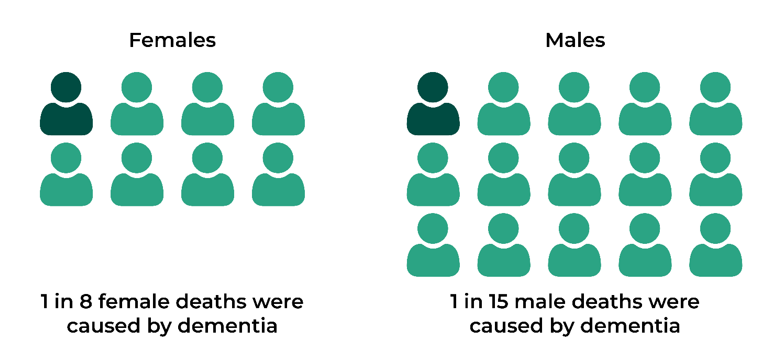
Source: Death registration summary statistics, England and Wales (2013-2021), Office of National Statistics.
The Deputy Minister for Social Services noted in May 2023 that the national census has confirmed that people are living longer, and that Wales is an ageing society. The census and other population projections suggest that we will see a very sizeable increase in those over 80 in the next few decades.
The biggest risk factor for dementia is ageing and By 2040, the number of older people living with dementia in Wales is projected to increase by 70%.
Source: Wittenberg et al. (2019). Projections of older people with dementia and costs of dementia car in the UK, 2019-2040. London School of Economics and Political Science.
Young Onset of Dementia
Young onset dementia is the onset of dementia when a person is under 65 years old. The symptoms of dementia may be similar regardless of a person's age, but younger people often have different needs, and therefore often require different support. There is a wide range of diseases that cause early onset dementia and a younger person is much more likely to have a rarer form of dementia than an older person. However, people under 65 do not generally have the co-existing long-term medical conditions of older people. For example, diseases of the heart and circulation. Younger people are usually physically fitter and dementia may be the only serious condition they are living with (Alzheimer’s Society, 2015).